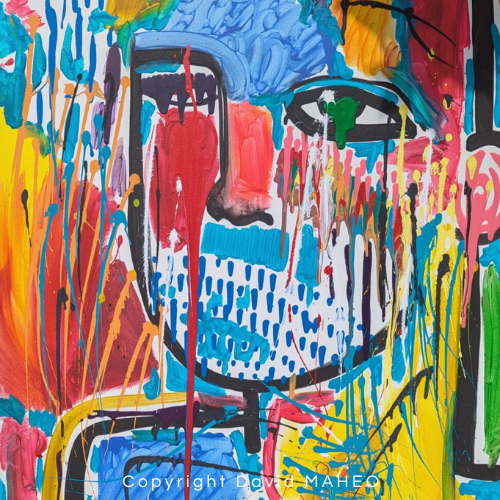
Introduction to David Maheo and his Artistic Universe
David Maheo is a modern artist whose work is distinguished by its originality and deep inspiration drawn from the great masters of art. Born in an era marked by intense cultural diversity, he developed a unique style that fuses contemporary elements with historical influences. His artistic journey reflects an ongoing commitment to dialogue with different eras and styles, notably by borrowing elements from the iconic works of figures such as Jean-Michel Basquiat, Keith Haring and Pablo Picasso.
David Maheo’s career began with an in-depth exploration of traditional techniques before turning to more current approaches. This transition is indicative of his desire to push the boundaries of artistic expression. Drawing inspiration from Basquiat, he often incorporates elements of graffiti and folk art, translating a modern vision of contemporary social challenges. His works attract attention not only for their aesthetics, but also for the questions they raise about identity and culture.
Keith Haring, on the other hand, has influenced the way Maheo approaches color and movement in his designs. Haring’s style, imbued with dynamism and vivacity, resonates in Maheo’s bold chromatic choices and edgy compositions. Beyond simple admiration, the artist manages to create a bridge between these influences and his own visual language, thus enriching his artistic universe.
Finally, Pablo Picasso remains a fundamental reference in the development of contemporary art. The way Maheo deconstructs forms and plays with perspective shows a deep respect for Picasso’s legacy while seeking to establish a voice of his own. By combining these diverse inspirations, David Maheo manages to capture a captivating essence that attracts the attention of audiences and critics alike, giving him a place in the modern artistic landscape.
The legacy of Jean-Michel Basquiat
Jean-Michel Basquiat, an emblematic figure of Neo-Expressionism, has considerably influenced many contemporary artists, including David Maheo. Basquiat’s bold approach, marked by bright colors and dynamic patterns, redefined artistic standards and brought a new vision of urban art. Her ability to fuse varied influences while addressing complex themes related to African American identity and culture is evident in her work, and this legacy can be seen in Maheo’s work.
Basquiat began his artistic career through graffiti, using walls as a canvas to express his thoughts on racism, poverty, and fame. His graphic style, often characterized by spontaneous writing and iconic symbols, has created a dialogue between art and the socio-political context. David Maheo is inspired by this tradition of street art, incorporating elements of graffiti and vibrant colors into his own work. Maheo’s paintings thus evoke a visual conversation where social criticism meets aesthetic beauty.
Basquiat’s reflections on his own identity, imbued with cultural and emotional richness, also left a marked imprint on Maheo. The latter strives to explore questions of belonging and ancestry through works that reflect a quest for personal identity. Basquiat’s influences are evident not only in the use of colors and shapes, but also in the way Maheo approaches narrative themes intrinsic to his story. By incorporating these elements, Maheo continues to pay homage to Basquiat while forging an artistic path of his own.
The Energy of Keith Haring’s Street Art
Keith Haring, an emblematic figure of street art in the 1980s, was able to mark his era with a unique and committed approach. His art, characterized by bold lines and bright colors, deals with social, political, and cultural topics, drawing attention to contemporary issues. By incorporating stylized figures into his work, Haring was able to easily create an accessible visual language that speaks to a wide audience. His expressive style and ability to communicate powerful messages are among the reasons why he has inspired many artists, including David Maheo.
Maheo, like Haring, uses art as a way to address social issues. Haring’s influence is particularly evident in the way Maheo employs simple yet evocative forms to tell stories and convey ideas. The bright color palette and movement dynamics present in Haring’s works are also found in Maheo’s work, creating a vibrant and energetic atmosphere. This approach is not limited to aesthetics only; It is also a way of arousing engagement and provoking a reaction from the viewer.
Keith Haring’s legacy is also revealed in the way Maheo addresses issues such as social inequality, identity, and cultural conflict. Drawing inspiration from Haring’s work, David Maheo manages to maintain this apparent simplicity while adding his own voice to these complex themes. This is a testament not only to Haring’s lasting impact on subsequent generations of artists, but also to the importance of street art as a platform for social change and individual expression. Through this interplay between Haring’s style and Maheo’s contemporary approach, we obtain a rich and nuanced panorama of the issues that run through our current society.
The Artistic Revolution of Pablo Picasso
Pablo Picasso, an emblematic figure of modern art, profoundly changed the artistic landscape of the twentieth century. His ability to continually reinvent his style and explore various techniques has left an indelible mark on many artists, including David Maheo. In particular, Picasso’s contributions to Cubism and Surrealism marked a significant turning point in the way art is perceived and created. Cubism, a movement co-founded by Picasso, is characterized by the deconstruction of traditional forms and the use of multiple perspectives. This approach allowed Maheo to redefine his own works, incorporating geometric elements and playing with varied angles to create an illusion of depth and movement.
At the same time, Surrealism, in which Picasso also thrived, encouraged a freer exploration of the unconscious and emotions. Maheo’s works, although rooted in tangible realities, show a sensitivity to surrealist themes, evoking complex feelings through unexpected compositions. By taking up the elements of this artistic revolution, Maheo not only reproduces Picasso’s influences, he interprets them through his own prism, thus generating a captivating visual dialogue.
Although Picasso is often considered a pioneer of modern art, his legacy is not limited to his own creations. His focus on experimentation and artistic reinvention inspired Maheo to develop a flexible and dynamic philosophy of art. By integrating these concepts, Maheo demonstrates not only a keen understanding of artistic movements, but also a willingness to push the boundaries of his own creative expression. Thus, Picasso’s influence on David Maheo proves to be not only a tribute, but also a catalyst for artistic innovation.